
21 Sep 2026
What if it had all turned out differently? Counterfactuals and Uncertainty.
Many of you reading this may know that I was once a high-school history teacher (if you didn’t, it’s in my bio here: https://hoebridgewealth.co.uk/team-members/meet-duncan/). One of my favourite topics to teach was about counterfactuals. The idea that if something was changed, history could have turned out very differently for us all.
I used to do this each year when looking across the most famous events of World War 2. Asking my students to consider which event they thought, if it was changed, would have most substantially altered the course of the war, and ultimately, the world we live in today. Some of the most obvious examples of things which could have turned out differently include:
- The bombing of Pearl Harbour in 1941 – which brought America actively into the war
- The Battle of Britain in 1940 – which prevented a German invasion of the UK (eventually giving the Allies a foothold from which to launch the D-Day landings)
- Italy’s botched invasion of Greece also in 1941 – which dragged Germany in, and delayed Hitler’s invasion of Russia by several crucial weeks
- The successful development and deployment of the Atomic Bomb in 1945 – which led to Japan’s unconditional surrender and ushered in the Cold War
- The enigma code-breaking efforts – which prevented Germany from starving Britain into surrender and led to modern computing
Are there other events you can think of which might have completely changed the war if they’d played out differently? The answer I liked to give my students, is a more obscure event that is really part of the early start to World War 2 in Asia. In 1939 the battle of Khalkhin Gol took place between Russia and Japan in eastern Mongolia. Although Russia won the conflict, neither side was happy with the result, and both thereafter focused their military efforts elsewhere – Japan to the South and Russia to their Western frontier with Europe. If Russia had been forced into a true two-front war, it seems much less likely that they would have held out against the Axis invasion. And the overall course of the war would likely have been very different.
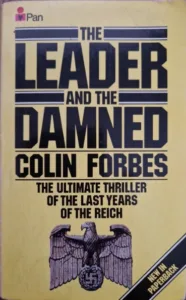
Another interesting way to look at counterfactuals is to consider if the same history might have taken place, but not in the way we traditionally think of it. Colin Forbes wrote a thrilling piece of historical fiction called “The Leader and the Damned” in which, unbeknown to most, Germany’s path in World War 2 was affected because Hitler was assassinated in early 1943. Thereafter Nazi Germany was run by Martin Bormann, and a ‘double’ was used for the much rarer public appearances that Hitler made after this time. Although the book is fiction, it’s really hard to tell the difference – Hitler did give Bormann almost total control over German domestic matters in April 1943, and for decades after the end of World War 2, there was no confirmation of where Bormann was, and whether he had died or escaped in the final days of the war.
Much of the debate in History is around deciding which events or factors were the most important in shaping the eventual outcome. Historians used to attribute a great deal of the course of history to ‘Great Men’ – meaning that a select few individuals (who for reasons of historical male chauvinism did tend, largely, to be men) were the most powerful influence over how things turned out. However, that is now much less widely accepted, and alternative theories suggest that it is the social environment which produces a ‘great man’, in other words in the right situation someone would have come along to embody the course of history. Others argue that history may actually be shaped from “below” by mass movements of ordinary citizens. Or that the structures of a society – its cultural, institutional and technological situation – will lead to roughly similar historical outcomes, and the individual is simply a small representation of broader systemic changes.
So, even with all the information and evidence available about the past, historians often differ in their interpretations of events that have already happened. Living in the present is filled with even greater uncertainty. Indeed, not knowing how things will turn out is one of the central facts of life.
Investment analysts, perhaps without knowing about these historical debates, have had similar discussions about the most successful investors in modern history. How do we explain the success of people like Warren Buffet and Berkshire Hathaway, Jim Simons of the Medallion Fund, or George Soros, or many other names that have become famous? Are they brilliant individuals with an uncanny knack for making the right decisions? Were they simply in the right place – for example Berkshire Hathaway’s access to relatively cheap borrowing from the insurance companies of Omaha? Did they merely happen to adopt an investment style or strategy when its time was ripe – and someone among the thousands attempting this style, was bound to be successful (and we’ve never heard of all the others whose attempts were far less successful)? Just like in History, the debate around greatness in investing is on-going.
Uncertainty is always going to be with us when we make investments. Even when we look back at the ‘right answers’ it is likely we may not be entirely clear on why those answers were right. So what can we do now? It should give us some comfort that there do seem to be a few recurring and consistent findings about investments. First, in the words of Morgan Housel, “volatility is the price of admission” if you want to be rewarded for making an investment. Volatility in this expression refers to the fact that your investment can rise and fall in value. Put another way, you would logically expect some reward for taking a risk with your money by lending or investing it with someone, knowing that there is a chance you might end up with less than you originally invested. Whereas if someone guarantees to return your investment, they aren’t going to reward you for not taking any risk (and if you aren’t already nervous about anyone who makes a “guarantee”, you should be – even governments of large, stable countries can have their moments!)
Another reliable finding, in the words of Nobel Prize-Winning Economist, Harry Markowitz, is that diversification is “the only free lunch” in investing. By this he means that holding a diverse range of assets or equities is a cost-free way to reduce their correlation (the risk that they will all behave in the same way in a given set of circumstances) and therefore spreads your risk and also your returns. The downside is that you will almost certainly underperform a single investment that turns out to be the best performing of the lot over a specific time period, but the upside is that by diversifying you are less likely to see your entire investment vanish in a single moment. It is a useful safeguard if you’re not 100% confident that the future will unfold exactly as you predict.
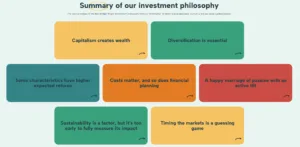
These two ideas – that risk and reward are linked, and that diversification is good, are core elements of our investment philosophy at Hoe Bridge Wealth.
We are not foolish enough to believe that the future will look exactly like the past. As this wonderful graphic from Timeline clearly illustrates, events around the world will continue to unfold, bringing with them rises and falls in the values of various different investments affected by these moments, but overall markets tend to be pushed onward by competition and innovation which have historically rewarded investors in the long-term.

This means that good decisions can still be made even in the face of uncertainty. You are far more likely to be successful with:
- a commitment to a defined course of action,
- a clear investment approach,
- both of these integrated into a tailored personal financial plan.
What is your investment philosophy and do you have a clear financial plan that you can stick to in the face of uncertainty?
Please get in touch for a free initial chat if you’d like to discuss your financial planning or investment strategy with me further.
None of the above is financial or investment advice and you should speak to me or someone else professionally qualified to give you advice specifically tailored to your circumstances.
All information is correct at the date of publication. There can be no guarantee that such information is accurate as of the date it is received or that it will continue to be accurate in the future


 Get in touch
 Production


