
21 Sep 2026
Is Greed Good Enough?
Classical economics has taught us that the self-interest of each individual can be beneficial for the economy as a whole. As each worker or business owner competes with others, they are pushed to create better, cheaper, more reliable, more helpful products and services to meet the needs and desires of customers.
In a similar way, the quest for better investment returns pushes everyone from the guy on his trading app at night, to the world’s largest financial institutions, to look for opportunities and to relentlessly scrutinise publicly traded investments. Any share price that appears to be inaccurate may be a chance for someone to make a name for themselves. And so, through the daily actions of millions of different investors, the market reaches a price that is felt to be fair, based on the information that is available for each company share, or government or corporate bond. This is the essence of the idea that modern investment markets are largely efficient.
Self-interest in classical economics and the theoretical concept of market efficiency both have significant real-world challenges. It is true, that in the twentieth century, communism was defeated at least in part because citizens of countries under authoritarian rule and centralised production structures, were envious of the apparent personal abundance that many people had in capitalism. In fact, China has since tried to chart a third way – state-directed capitalism: in which citizens are diverted away from political autonomy, in favour of pursuing personal material wealth and consumer goods. With the result that these days China is a critical pillar of the global luxury goods market – generating perhaps a quarter of all personal luxury sales worldwide (per EDHEC Business School).
Is a wider and more colourful range of designer shoes, handbags, and watches, an optimal output, given all that humanity is capable of, and the tremendous technological advancements we have made? Have things become a bit skewed, to call capitalism a triumph despite all the societal challenges we still face? When we currently have growing economic inequality – according to the United Nations about 71% of the world’s population lives in countries where inequality within the country has increased over the last 25 years – and also increasing youth-unemployment in many countries, even the most prosperous?
Similar questions are worth asking about market efficiency. In investment markets, we have so-called High Frequency Traders (HFT) that execute huge volumes of trades each day (some individual firms now trade more shares in a single day than the entire New York Stock Exchange – per CNN.com), often operating at the level of milliseconds, to exploit gains that may be fractions of a cent per share. Incidentally, many of the world’s most successful hedge funds and HFT firms have used these strategies to profit enormously from the predictability of passive index-investing, “collecting rents on the automation of asset management itself” (Resonanzcapital.com). Ironically, as these traders become better and better, the margins to be earned get smaller – effectively, they are eating their own lunch. In recognising the law of diminishing marginal returns, at what point is there limited real benefit being delivered to pension funds and ordinary investors, from an improvement in price efficiency that is so tiny?
For investors, the bigger issue is that efficiency and overall accuracy may not be the same thing. Effectively, the whole market can be efficient but still wrong about the real value of an investment. This is why markets are driven not only by greed, but also by fear. History is replete with examples of prices that have been haggled over by a wide range of bidders, both buyers and sellers, but with most of them missing something fundamental about the underlying value of what is being bought and sold. This presents significant opportunities if an investment is under-priced – which is the entire basis of the philosophy of ‘value-investing’. It also contains major risks if excessive hype is included in overall ‘fair’ market prices – as happened in the late 1990’s with the Dot.com bubble where early internet companies were valued far beyond their real earnings.
One of the most famous examples from that investor mania is Cisco Systems, which at one point was trading at just over 200 times its earnings before the share price collapsed on March 24th 2000 (ICIS.com). By comparison, as of mid-2026 the price/earnings ratio (price paid for a share vs profits earned per share) for the Magnificent 7 (Nvidia, Apple, Amazon, Microsoft, Alphabet, Meta) were all between 23x and 35x , the exception being Tesla, at 335x (Macrotrends.net). However, markets have been watching with some trepidation, as many of these companies have continued to heavily invest their cashflows into infrastructure and AI development, although for now they remain exceptionally profitable.
One of the problems of capitalism is that consumers are constantly bombarded with messages trying to entice us to buy the next new shiny thing. This sort of marketing also extends to investments. Promises of untold riches, investments that can never lose value, and hidden financial opportunities no-one else has spotted, are surprisingly abundant on social media and even in newspaper or online articles that give investment tips to the reading public. As if much investment edge is likely to be left by the time you’re reading about a ‘hidden gem’ in a newspaper!
The ‘shiny’ investments being offered need not be implausible. Some respected investment advisers advocate for high-risk products that can give significant income tax breaks. Others push for portfolio diversification into private companies or private debt, or specific individual stocks or commodities. A common tactic used by banks and high-charging traditional investment houses is to build a convoluted portfolio including a swathe of different funds – but on closer examination, these different funds are all doing very similar things and are invested in nearly identical lists of underlying companies and bonds. The apparent complexity is like “jewels” or a logo stamped on the outside of a handbag that would otherwise have cost less to purchase.
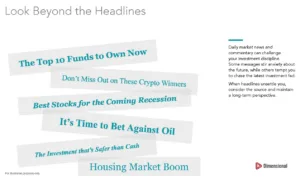
All of these messages are appeals to human greed and fear. This hype and constant clamouring about new and different investments is something prudent advisers refer to as ‘noise’. And one of my most important roles with clients is to encourage them to be ‘cautiously greedy’. Not to be swayed by the investing equivalents of “designer shoes” or “luxury fashion” that may fall out of favour as quickly as they rose, but instead to invest patiently for the long-term in things that are easy to explain. Warren Buffett famously described the stock market as “a device for transferring money from the impatient to the patient” (Investopedia.com).
Working with a good financial planner should focus on tailored financial planning, with your individual time frames and goals clearly in mind. This allows you to trust that while specific inaccuracies may be a persistent feature of markets, the compounding effects of competition over time can and do continue to produce long-term returns for patient investors. Here’s a short clip from Dimensional Fund Advisors on the difference having the right financial advice makes (note: this is focused on American investors and does specifically highlight events that strongly affected US investment markets, but the ideas apply equally well to investors anywhere else in the world). https://www.dimensional.com/us-en/iap/287984/the-difference-the-right-financial-advisor-makes
How do you avoid being distracted by noise, or “shiny things” that the modern world is so good at dangling in front of us?
Are you clear on your personal financial plan and what you’re aiming to achieve? Do you have the right support to get you there?
Get in touch if you would like to have a chat or would like to set up a no-obligation conversation with me for someone you care about.
NOTE: The value of your investment can go down as well as up. Past performance is not a reliable indicator of future results. None of the above is financial or investment advice and you should speak to me or someone else professionally qualified to give you advice specifically tailored to your circumstances. All information is correct at the date of publication. There can be no guarantee that such information is accurate as of the date it is received or that it will continue to be accurate in the future.


 Get in touch

 Production


