
22 Jun 2026
Schrodinger’s Conversation – Do you Dare Ask?
Rumour has it that Bill Gates was spurned for many years despite his desire to become a member of Augusta National Golf Course, the home of the famous Masters tournament. His crime? He made the mistake of letting it be known that he wanted to join. Apparently, this is a serious transgression and prevents the person from being considered for membership*.
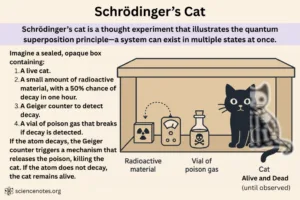
I liken this conversation to the famous Schrodinger’s Cat though experiment – in which a cat is inside a box and is considered both alive and dead, until the box is opened. I’ve always wondered whether, when you open the box, you might kill the cat (or yourself) anyway, given that the box is said to contain a vial of poison and a radioactive atom?!
Anyhow, if Bill never asks anyone how you become a member of the golf club, how exactly does he ever find out? And more importantly, how will anyone ever know that he would like to be considered? I’m sure there’s some sort of ritual dance, like birds deciding whether they like a particular suitor’s nest or not, but it does seem a little absurd not to be able to start the conversation.
But there are often aspects of our own lives that are remarkably similar to this problem of not speaking about something because we’re not sure what will happen if we do.
Take mental health, for example. If a person is struggling, one of the biggest problems they face is the feeling that there is no-one they can share their problems with. They often fear that by admitting their struggles, they will somehow make them more real, or a larger part of their lives. Or they’re afraid that admitting to difficulties with mental health will lead others to label them, or even reject them, so that they end up worse off. And yet, by not speaking with anyone, usually their problems get worse rather than better.
In fact, not speaking about things and letting them fester has strong links to depression and even suicide, particularly among men age 15-50, but also for many other women and men. This is something I’m particularly conscious of, as it’s a point of focus for one of my favourite charities – The Movember Foundation. Have a look here for more on the topic of starting, and being part of proper conversations with others you care about: https://uk.movember.com/story/view/id/11508/because-men-are-willing-to-talk-if-you-ask.
But the truth is, if you’re aware of a difficult conversation that should be had, you’re likely not the only one who feels the elephant in the room. There are lots of coaching, therapy, and self-help guides with suggested ways to get started, but here are a few tips to consider:
- Avoid creating mental conversations before you get to the real ones (your mind builds up walls that may not actually be there),
- Some of what you think and feel may be wrong, be open to this,
- Stay away from accusation or blame, and never start from this,
- Make sure that you listen carefully as well as talk,
- Often it takes several conversations to get things resolved – start the conversation and then stick with it.
(Taken from the Grit and Grace project – https://thegritandgraceproject.org/relationships/why-you-should-just-have-that-hard-conversation-and-how-to-do-it)
My own work does also feel at times like it has some “Schrodinger” type conversations that people are afraid to start because they’re not sure what will happen when they open the box:
- Ensuring sufficiently robust contingency plans are in place in case of a career-change, a prolonged serious illness, or a death in the family;
- Saving and investing enough to fund your future when you are no longer as full of energy and your desire as well as physical and cognitive ability to work may be reduced;
- Figuring out what being retired actually means to you and how you’d like to live, and what you need to have invested to afford that lifestyle;
- Assuming that you’re going to live forever and therefore don’t need to make any plans that consider those who will be left behind when you die;
- Treating money and talking about values around money as a taboo, rather than an integral part of a shared family culture;
- Grown-up children opening up to their parents about their own finances, in order to start a much broader family financial planning conversation – rather than everyone relying on guesswork or being afraid to offend or patronise.
Sometimes my work is about helping people to start those conversations or plan their way to having them be effective. This is not a technical part of financial planning, rather, it is in the emotional and psychological sphere of how money and wealth intersect with our lives and our relationships.
Have you dared to start an awkward conversation? What is holding you back? Would it help to have expert support with decision-making or an outsider perspective to help facilitate the conversation?
If you would like help with thinking more about any of the above, please get in touch for a free initial chat.
*Bill Gates is now a member of Augusta National: they say money can’t buy you everything, but it certainly seems to help you get friends in high places, or to escape social conventions! 😄
None of the above is financial or investment advice and you should speak to me or someone else professionally qualified to give you advice specifically tailored to your circumstances.


 Get in touch
 Production


