
27 Jul 2026
Does Artificial Intelligence (AI) mean No-One Needs Financial Planning?
Like many people in skilled, desk-based work, I have had to consider the disruptive influence of Artificial Intelligence (AI). Both from an investments perspective and a career outlook.
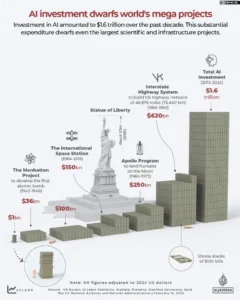
For investors, the scale and magnitude of the bets being taken on AI are almost incomprehensible. Global investment in AI is projected to reach $2.5 trillion in 2026, a 44% increase over 2025. To put this in context, total spending on the 46,876 mile US interstate highway system between 1956 – 1992 was only $620bn (adjusted to 2024 dollars) (https://www.aljazeera.com/news/2026/2/19/visualising-ai-spending-how-does-it-compare-with-historys-mega-projects).
Concerns over whether AI has been overhyped are often on the minds of investors. JP Morgan, an investment bank, created an equity basket of 30 companies in the S&P 500 that are most impacted by AI. By October 2025 this index accounted for 44% of the S&P 500’s total value (https://www.bankofengland.co.uk/bank-overground/2025/all-chips-in-ai-related-asset-valuations-financial-stability-consequences). The list includes ‘Hyperscalers’ such as Microsoft, Alphabet (Google), Meta (Facebook, Instagram, WhatsApp), Oracle; AI Chipmakers including Nvidia and AMD; AI Applications including Tesla, Uber, Salesforce; and related Utilities and Infrastructure companies.
Even outside of the S&P 500 the impacts of AI have been notable. A recent article in The Economist (“Japan, South Korea and Taiwan are suffering industrial rot” – unfortunately only accessible with a subscription) observed that while Taiwan, South Korea and Japan have all enjoyed notable successes recently in chipmaking for AI, in fact their other manufacturing exports are rapidly receding in the face of Chinese competition and increasing global protectionism. Again, for investors this is concerning: as of early June 2026, the MSCI Emerging Markets Index allocated 14.46% of its total holdings to a single company, Taiwan Semiconductor Corporation (https://www.msci.com/indexes/index/891800), meaning that chipmaking firms have also taken an oversized role in Emerging Market tracker or index funds.
And there is more coming to investment markets, as SpaceX and OpenAI have both announced intentions to become publicly listed companies – with projected valuations that are likely to catapult them directly into lists of the largest public companies in the world. This will then soon require passive index tracker funds to buy significant quantities of their shares when they become available, even if they’re over-priced.
Another big shift has been the increasing capital and energy intensity of big technology companies. Big tech firms were previously credited with moving things into the cloud and making tasks paperless, thereby reducing the carbon intensity or material consumption associated with work. They were therefore seen as sustainable investments. Over the past five years however, the demand for electricity from data centres that power AI has grown by 12% per year, more than four times faster than overall global electricity consumption growth (https://www.iea.org/reports/energy-and-ai/energy-demand-from-ai). Cooling data centres has also led to rapidly rising demand for water. These changes mean that big technology companies, which were previously a mainstay of portfolios that took into consideration environmental factors, may now be much less sustainable (https://www.sustainalytics.com/esg-research/resource/investors-esg-blog/artificial-intelligence-versus-reality–the-esg-risks-behind-the-ai-boom). Indeed, it seems highly likely that the largest index-compilation and ratings companies will significantly shift the sustainability weightings given to these companies, as a result of the resource-hunger of their AI development efforts. That is likely to produce greater investment performance divergence, and different risk-exposures, for ‘sustainable’ vs non-sustainable investment approaches.
So, despite these environmental concerns, why is so much money pouring into AI? A simple analogy is that AI tools might do for skilled work the equivalent of what machinery has done for road-building or extraction of minerals in mining. Allowing far more work to be done by the same number or even fewer people. Imagine being able to offer a piece of software that allows the world’s largest companies to replace swathes of their unreliable, sometimes ill, often grumbling desk workers, with tools that perform relentlessly and get better, at a faster rate? How much might it be worth to provide such tools?
There are likely to be big winners and losers in the AI arms race: with several technology companies aspiring to ubiquity or market dominance. Think for example of how in many parts of the world we currently refer to searching the web as ‘Googling’. However, even dominance that seems permanent, very rarely is. We may still hear people refer to a ‘hoover’ when they vacuum the floor, but that doesn’t mean they buy the brand name that was originally synonymous with the product. It is also not clear whether those in charge of the AI race have thought carefully through the results of their labours – there are clear parallels with the scientific development of nuclear technology, which promised nearly limitless power generation, but also turned out to be a formidable and potentially civilisation-ending weapon. AI development, left unconstrained, could also unleash automated warfare, computer viruses without antidotes, or even perfectly engineered biological or chemical weapons for anyone with a computer and a home laboratory.
From an investor perspective, things are moving so quickly that it may be wisest to ride it out and see what happens, but also to accept that only afterwards will we know who positioned themselves best for either total AI success and global economic dominance, or found themselves riding a bubble similar to the “dot.com” investment hype of the late 1990s. Our investment philosophy at Hoe Bridge Wealth (https://hoebridgewealth.co.uk/who-we-are/our-investment-philosophy/) advocates global diversification of investments, and slight tilts towards smaller, value-style, profitable companies that historically have produced better long-term returns. This may also partially shield against the currently eye-watering share prices (and price-earnings multiples) of some of the big tech companies and the possibility that some of them may fail to reach their goals despite huge investments in fixed capital. The only thing we can be sure of is that the future will not look exactly like the past.
For many professionals, the more personal question that lurks not far below the surface is about the intention for AI to disrupt their own work. Boston Consulting Group already estimates that over the next two to three years AI will reshape 50% to 55% of all jobs in the USA (https://www.bcg.com/publications/2026/ai-will-reshape-more-jobs-than-it-replaces). In a wide range of professional fields I have also spoken anecdotally with friends and clients here in the UK whose work is rapidly being transformed by the use of AI.
I have seen it too in my own field. Many of the building blocks of financial planning can now be obtained by asking lots of questions to an AI tool such as Claude, ChatGPT, or Gemini. You can build a reasonable personal cashflow model in a matter of a few hours at most. You can ask AI for ideas around portfolio construction and use it to probe the strengths and weaknesses of existing investment approaches. You can get it to help you create a personal financial plan – with various suggestions around effectively using different types of investment account, including ISA, Pension, General Account, and even other more esoteric types.
There’s a problem here though. The outputs from these tools are always explicitly noted as not being advice on what you personally should do. Which seems surprising: why don’t these large technology companies build robot-advisers and take over huge slices of revenue from humans? (It has already been tried a few times in fact). Very simply because the technology providers aren’t confident that there won’t be mistakes. Mistakes that could lead to costly legal settlements, especially for clients with more substantial investments.
When I speak with someone about financial planning, yes they want technical answers. And yes they seek to understand the plethora of options available to them and the pro’s and con’s of each choice. But what they really want to know includes:
- Have they missed out a crucial question?
- Are their assumptions accurate and realistic?
- Will they arrive at an answer they feel comfortable acting on and confident in adapting over time?
- How will they be kept informed and accountable for sticking to their plan?
The hugely expanded accessibility of information today is both a blessing and a curse. You only have to look for investment ideas and you will be inundated with a huge range of opinions and often unregulated advice – not just online, but also from advertisements, journalists and economic commentators, social media and videos, and even friends and well-meaning acquaintances. And the world keeps changing around us – whether it’s taxes, investment markets, regulations, or your own personal circumstances and needs. Which is why I’m a firm believer that financial planning is most valuable as a long-term partnership between me and each person I work with. My clients value the support I provide them – helping to tune out the “noise” (https://hoebridgewealth.co.uk/client-stories-tuning-out-the-noise/) as well as prompting them to continually re-focus, and adapt their plans as needed.
So yes, AI is going to change a lot about our world – some of it will be really good, and some of it will be destructive. But nuanced decisions, rooted in human needs and wants and not simply technical criteria, are likely to be best supported by meaningful conversations with someone with the both the skills and humanity to support your unique circumstances.
Have you thought carefully about your financial planning and how you are preparing for the future?
Get in touch if you would like to have a chat or would like to set up a no-obligation conversation with me for someone you care about.
NOTE: The value of your investment can go down as well as up. Past performance is not a reliable indicator of future results. None of the above is financial or investment advice and you should speak to me or someone else professionally qualified to give you advice specifically tailored to your circumstances.


 Get in touch
 Production


