
26 Oct 2026
Can You Make Better Decisions? What if Life is more like Poker Than Chess?
John von Neumann, is considered the father of Game Theory, a field of economics that considers decision-making, hidden information, chance, and the interaction of multiple people in decisions. He argued that chess is not a game – it’s a well-defined form of computation, with no hidden information and very little luck. When a lower ranked Grand Master beats a higher ranking one, it’s because the loser made one or more mistakes that are objectively identifiable.
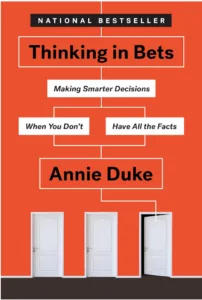
In her book, “Thinking In Bets”, Annie Duke, a World Series of Poker bracelet holder, and also a graduate-level researcher in psychology, argues that life has much more in common with Poker, or any other game that involves uncertainty, risk, and occasional deception.
This approach has a number of very interesting implications for how we might want to approach decision-making and life in general.
First, too often we look at the outcome of a decision to decide whether it was good or bad. Duke refers to this as ‘resulting’ – judging a decision by the result. The truth is that a bad decision can still have a good result if you’re lucky – just because you didn’t have an accident, doesn’t mean you should have driven while tired. And similarly, a good decision, with a bit of bad luck, can end up not producing the result that you hoped for – we often see this in sports where the ‘right’ play doesn’t necessarily result in a win every time.
The key here is that uncertainty, or what you don’t know, can produce a great deal of mischief. Ask anyone what the odds are of a coin being flipped and landing on ‘heads’. Most of us know that mathematically the answer is 50/50. And we can answer that with confidence. But if you haven’t looked closely at the coin, how do you know it isn’t a trick coin with two tails? If you haven’t seen it flipped, or perhaps even weighed it, how do you know that is isn’t a coin rigged in favour of one side over the other? As humans we tend to be very ready to make typical assumptions.
We should all be much more willing to express uncertainty. To acknowledge that even with a very strong hand, it is impossible to know exactly what other cards may appear. A really good place to begin learning from is likely to be “I don’t know…” Where we recognise the limits of our knowledge, and accept that learning starts from the point where we identify what we don’t already know. This implies that it is wiser to acknowledge doubt than to be over-confident, given the unexpected and hidden variables that may be out there.
Even with clear information, people often get probabilities wrong. Not the forecast odds, or polling indicators, but what they actually imply. For example, a 33% chance in April 2016 that the Leave vote would triumph in the Brexit referendum (as observed on TheConversation.com on April 12th 2016), was not in itself a flawed forecast. 33% still means that roughly 1 out of every 3 times, there was a chance that Leave would have a majority in the vote. Any odds between zero or 100% mean that in fact both outcomes are possible (and just to complicate things, in many bets there are also other possible outcomes such as a draw, or an abandoned match or spoiled result).
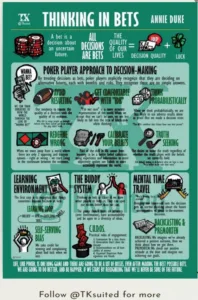
Does this mean that we give up all hope and resign ourselves to medieval superstition and ignorance? Absolutely not. Instead, Annie Duke suggests a few sensible ways to improve decision-making:
- Be more open-minded and aim to be more objective: our beliefs can strongly cloud our assessment of the game, and the decisions we assume are available to us. In fact, humans are remarkably prone to forming beliefs very quickly with very limited supporting evidence, and then very slow to unwind those beliefs. One way to re-asses your beliefs is to examine them as though someone has just asked you “Wanna Bet?” This may prompt deeper reflection and interrogation of your information, where before you were casually confident.
- Think probabilistically: instead of asking whether you’re confident, try to pinpoint ‘how confident’ you are about something – would you rate it 5 out of 10, or 9 out of 10? Expressing a level of uncertainty also invites others to collaborate with you instead shutting down different views. Also ask yourself, how much do you really know about the subject (beware the Dunning-Kruger effect!) – the better quality information you have, the tighter your range of plausible alternatives.
- Redefine what it means to be wrong: acknowledge that the world is full of random factors, and try to see failure not only as a potential learning opportunity, but also to accept losing as an inevitable part of playing. You don’t have to like it, but don’t let it take too much emotional toll as this clouds your learning. Famously, Roger Federer won only slightly more than half of all the points he played, and was still one of the most successful tennis players of all time, in part because of his equanimity when he perhaps wasn’t playing his best.
- Understand that all decisions are bets: a decision is a choice you make about what will probably happen – and a choice among various future versions of ourselves. This includes those future paths we are not choosing – so any choice also has an opportunity cost of what is foregone (this includes sticking to things as they are right now).
- Accept that evaluating success vs failure is difficult because the outcome is determined by both decisions (skill) and luck – either of which may be decisive. One effective way to avoid self-confidently assuming the good outcomes were our skill and the bad outcomes were luck, is to build yourself a group, which Duke refers to as a ‘Thinking Pod’ – with:
- diverse viewpoints and intellectual diversity – requiring at least three people (“two to disagree and one to referee”)
- advance accountability – where predictions are made before the outcome is known, to avoid retrospective reasoning
- a commitment to truth-seeking over emotional confirmation
- an openness and encouragement of identifying and admitting mistakes, and gentle checking of lazy thinking or emotional rants.
In my own work, I have to walk a fine line between confidence and reasonable doubt. Many people seek reassurance that they are making good decisions with their personal finances. And my experience and expertise can certainly help them to narrow the field of likely outcomes, and to avoid what might clearly be mistakes. Like a ‘thinking pod’, part of my role is to gently check assumptions at times, and to help people uncover where they may be less certain about their future selves than they might like to admit.
My firm’s investment philosophy is likewise backed by decades of research produced by Nobel Prize winning economists far more knowledgeable than I am. Their findings suggest strategies that have better than average odds of producing good long-term investment outcomes. But I never express the sort of utter conviction or certainty that some salespeople do. Because the world is full of surprises, and I don’t have all of the information – neither does anyone else.
So together we make financial plans and investment decisions with a healthy degree of scepticism about the future and our own ability to distinguish between skill and luck. To quote Baz Luhrman, “prices will rise, politicians will philander, and you too will grow old…” Being careful not to be too overconfident, I have found, actually gives people greater reassurance that their plans are robust. A clear financial plan that can be acted on in a positive manner, and when built as part of wider a strategy for playing the game of life, it is often a great source of peace of mind about the future.
How do you ensure that you’re making good decisions? Do you have a clear financial plan that you can stick to in the face of hidden variables and luck?
Please get in touch for a free initial chat if you’d like to discuss your financial planning or investment strategy with me further.
None of the above is financial or investment advice and you should speak to me or someone else professionally qualified to give you advice specifically tailored to your circumstances. All information is correct at the date of publication. There can be no guarantee that such information is accurate as of the date it is received or that it will continue to be accurate in the future.

 Get in touch

 Production


