
27 Jul 2026
We Need To Talk (about Wealth)
In the early 1990’s, two years after finishing university, Jennifer Risher moved to Seattle, Washington. She started working at Microsoft, and was pretty pleased to receive a big bump in her salary to $26,000 per year. Part-way through her second year at Microsoft, she realised that the stock options that formed part of her employment package, were already worth as much as $300,000 (in today’s money that would be $712,000 or approximately £530k). She met and later married a co-worker at Microsoft who after being very successful at Microsoft, left to join a friend of his Jeff, who was starting a new online book-selling business that we now know as Amazon. His stock options turned out to be worth quite a bit too!
“We Need To Talk” is Risher’s memoir about her experiences of becoming a wealthy person despite coming from relatively modest beginnings. She explores with great honesty, her mixed feelings about the money, and the privilege that she became part of and was surrounded by.
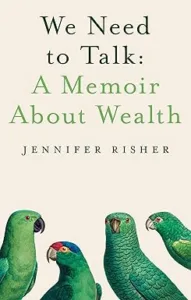
It is a very easy-to-read book. And the memoir style helps to bring some humour and relatability. For example, she recalls the amusing story of an early weekend away with her future husband where they travelled to a cheaper airport, and flew at an awkward time, and had to catch a long transfer shuttle to the city they were visiting – all of which actually made their weekend away much shorter and less enjoyable than if they’d been willing to spend just a little bit more.
Very few of us may be destined to become deca- or centi-millionaires, but we can still identify with some of Risher’s experiences. I can certainly remember as a teenager, agonising over which CD to buy for a few pounds. Or carefully checking the specials board to work out how to get the most food for my money. Little realising at the time that ‘adulting’ means handling far larger bills and responsibilities.
Each chapter also highlights some important questions which may give us food for thought about our own lives and relationship with wealth:
- What assumptions, emotions and thoughts about money were part of your childhood?
In Risher’s case she realises that her parents disapproved strongly of ostentatious displays of wealth, and made assumptions about certain ‘types’ of people based on their visible spending habits. That made it harder for her to give herself permission to enjoy a more luxurious experience even when she could afford it. And left her worrying about what others would think of her when she did. - How do you account for your successes and failures – what part is talent or hard work, and what part choices, or luck?
This can have a big impact on how we feel about using our wealth, and can also shape our attitudes for example to taxes, and gifts or legacies for others. - What do you believe about people who have a lot of money?
This is especially relevant for those who have become a success from more humble beginnings: often there is a fear or anxiety about losing our roots or the values that defined us and helped us to achieve our success (I have explored this much more in another article – Strangers in Paradise – https://hoebridgewealth.co.uk/thinking-anthropology-and-the-land-of-wealth/). - How do you talk about money and with whom?
Risher rightly identifies that it can be very isolating not being sure who it’s safe to reveal our wealth to. There is fear of being judged, or of being taken advantage of, that relationships will change if people know your true net worth, and also the fear of what knowledge of wealth might do to children – for example robbing them of ambition or drive to succeed on their own.
Relationships within families can also be impacted where money becomes involved – whether with siblings or parents – and this can make it hard to talk about money even with those most closely related to us. - Does wealth change us, or merely reveal more of who we are?
Risher calls wealth a ‘truth serum’ – noting that she and her husband often found much greater psychological challenges over spending smaller amounts, than they did the big items. It was a crucial realisation for them very early in their marriage that they needed to communicate well, to ‘talk’ properly about what they were comfortable with or agreed on, and where they differed to understand clearly why that was the case.
The memoir also observes that sometimes we’ve grown up with the illusion that having money will solve all our problems. In reality, unhappiness, hassle and annoyance, and even moral and existential questions are all still very much a part of life and cannot be solved by money alone. - There are many more areas of thinking about wealth that are explored in the book, including: hiring help to free up time and energy; education and the school environment’s attitude to wealth and material needs; giving to others and cultivating a sense of responsibility that come with privilege; the perils of “keeping up” with friends and media ‘glamorisation’ of wealth; balancing ambition and the sense of having ‘enough’ – including our non-financial ambitions and satisfaction (e.g. just because you can afford to retire might not mean you want to).
I mainly help clients with three different problems, and the questions raised in “We Need To Talk” touch on all of them.
- For those planning for or approaching retirement, often we need to work through together not just the technical and financial aspects of retirement, but also questions of lifestyle and meaning that are crucial to an enjoyable retirement.
- For business owners it can be very difficult to effectively identify how much is ‘enough’ – both financially and emotionally. It can be really helpful to have someone like me with whom you can openly discuss and celebrate the success of the business and also how to effectively translate this into meaningful personal rewards.
- For families looking to preserve wealth or to support future generations, I help you to navigate the balance between numbers and technicalities, and also relationships and emotional connections. Including how best to support children or grandchildren without depriving them of their own meaning.
Would you or someone you care about like to have a conversation about wealth and how to make it work in your life?
Please get in touch for a free initial chat.
None of the above is financial or investment advice and you should speak to me or someone else professionally qualified to give you advice specifically tailored to your circumstances.


 Get in touch
 Production


