
26 Jan 2026
Thinking: Are there really some bad questions?
Challenging conventional wisdom: Very often we hear a speaker (or a teacher) say, “Please ask questions, there are no bad questions”.
And while I understand the spirit of encouraging each of us to make sure we really understand the subject matter. What if there really are some bad questions?
It depends a lot on the conversation you’re having and what its purpose is.
In my professional development as a financial planner, I’ve been working really hard to develop better listening skills. (I have a long way to go, particularly if you ask my wife! 😄) And I’ve learned that the worst thing you can do when someone is trying to probe and explore their own thoughts, or feelings about the situation they are in, is to interrupt them.
Even if it’s to ask a perfectly reasonable or supportive question, you derail their train of thought, and you move the focal point of the conversation from what they were thinking, to what you are focusing on.
We hear often that good listening involves showing the speaker that we’ve understood them. It means playing back to them what we’ve heard, to make sure we have grasped their meaning, and probing their thoughts to understand the linkages. And these are both valid and useful – at the right time. But first, to really hear what someone is saying, you should let them lead the conversation and speak more, and do your best to listen supportively. Nothing more is really needed beyond nods of the head, affirmative noises (uh-huh, mmm, yes…), and sometimes a little silence to let them ponder things before they continue. Let them get it out and stay out of your own way if you really want to hear what’s on their mind.
I try (not always very well) to take notes about any questions I have as I let the other person speak. But this loses eye contact that is often vital to their connection to you and the thoughts they’re having. In an ideal world, a really good conversation might involve an assistant who has the skill to note down the exact same key points or questions that I would, but no two people think alike so I make do with digital recordings of meetings, along with jotting down the occasional point of interest or concern, to revisit.
I can learn an awful lot by letting the person or couple I’m with tell me their answers and give me insight into not just what they are thinking, but how they may be feeling.
I am of course lucky (and given my hearing impairment it’s no accident) that I’ve moved to conversations with 1 or 2 eager participants, so that I’m in meetings where there aren’t too many people to juggle.
Nancy Kline, in her book Time to Think, has some excellent suggestions around how even much larger organisations can create a culture and a meeting structure to incorporate world-class listening and really getting the best thoughts out of everyone in a group – rather than the dominant voices crowding out valuable perspectives.

Financial planning itself has undergone a massive transition over the last few decades. What was once an extension of the insurance and pensions industries, simply selling policies to people, has become a much more holistic exercise built around trying to understand the levers that are pulling and pushing the decisions a person is making with their finances.
I often say to people I help, there isn’t necessarily a single “right” answer to their situation. Instead, there’s an answer that ‘feels’ right for them – and this is based on who they are, what they want to achieve, and what trade-offs (and there are always trade-offs) they are comfortable with. Understanding all of those things comes from listening to them more deeply in the hopes of gaining a better understanding of their values and goals.
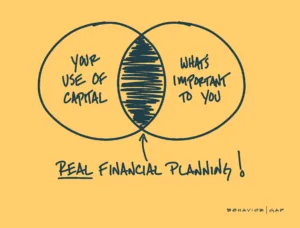
Would you like to have a meaningful conversation with someone about your money and its place in your life, including how it will support your future aspirations?
Get in touch if you’d like to start a conversation.
None of the above is financial or investment advice and you should speak to me or someone else professionally qualified to give you advice specifically tailored to your circumstances.


 Get in touch
 Production


